
Sometime after 30, the body gives back a little muscle each year, and the loss speeds up after 60. Exercise scientists call it sarcopenia, and the rough figure most of them use is a drop of around 3 to 8 percent per decade.
That sounds like a sentence you can do nothing about. It isn’t.
Resistance training is the proven counter, and it works at every age. The famous demonstration came in 1990, when a study in JAMA put frail adults in their late 80s and 90s on a short program of weight training. They got measurably stronger, and people who could barely rise from a chair walked better afterward.
So the question is not whether your body can still respond.
It can.
The real question is how to start without hurting yourself, and without a gym, a program, or a younger version of you that is never coming back.
Why strength matters most after 50
You have several kinds of fitness to spend time on: endurance, flexibility, balance, strength. They all matter.
Strength is the one that matters most after 50. It is what lets you carry the groceries, climb the stairs, and get up off the floor without thinking about it.
It also props up the others. Strong legs steady your balance; a strong back makes a long walk comfortable instead of punishing. When people lose independence later in life, it is usually not the heart that fails first. It is that the body got too weak to do ordinary things safely.
Strength is the master skill of staying capable after 50, it protects everything else.
And here is the part the headlines miss. Most age-related decline is trainable, not inevitable; the body still adapts at every age. Muscle responds to a demand placed on it whether you are 35 or 75. The response is slower at 70, but it is real, and it is enough.
The get-up-from-a-chair reality check
Here is a test you can do right now, no equipment.
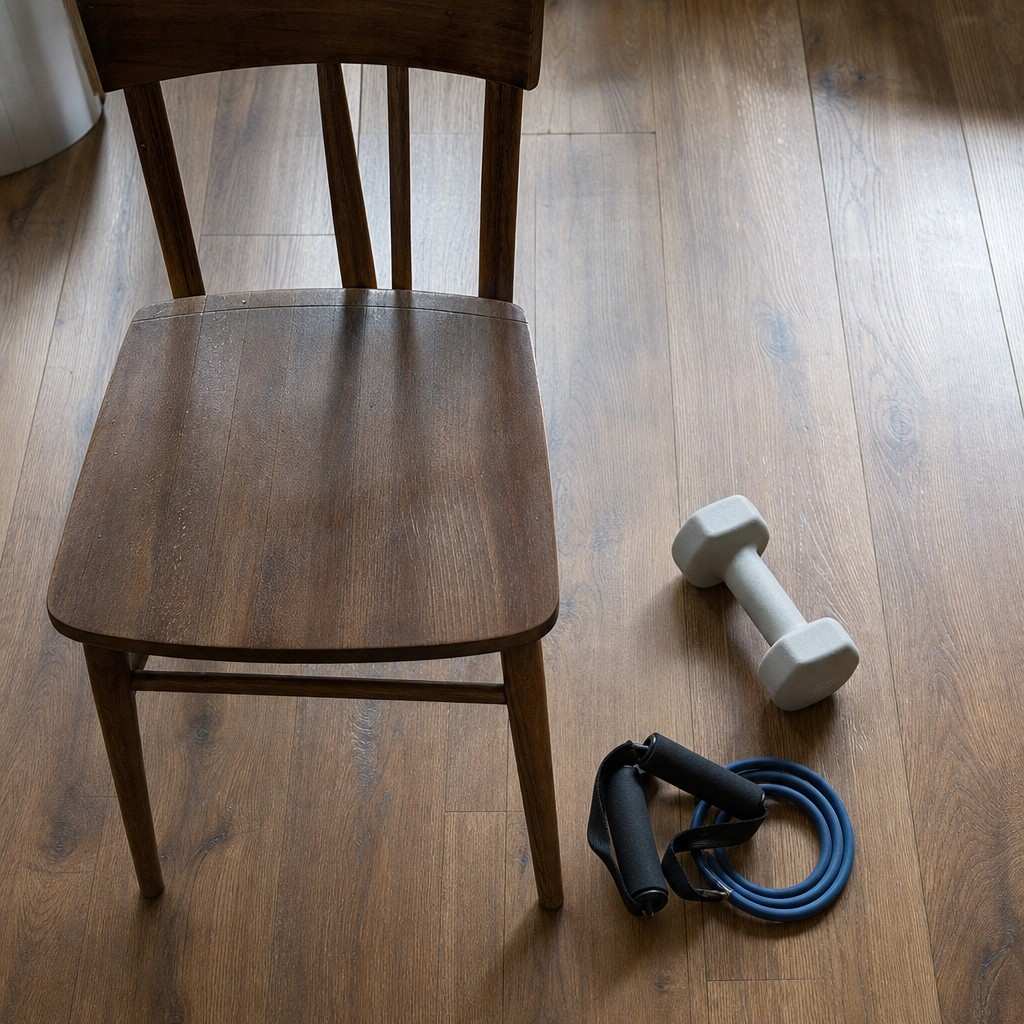
Sit in a normal kitchen chair, fold your arms across your chest, and stand up without using your hands. Then sit back down the same way, controlled, not a drop.
If you can do that smoothly a few times in a row, your legs are in decent shape. If it is a struggle, that is useful information, not a verdict.
None of this is a diagnosis. It is a snapshot of the leg strength, power, and balance that quietly keep you independent. And every bit of it is trainable.
The chair is not a test you pass or fail. It is a baseline you come back to in two months to see how far you have moved.
How much you actually need
Less than you probably think.
The CDC and the WHO both recommend muscle-strengthening activity on two or more days a week, and both say this explicitly includes adults over 65. The American College of Sports Medicine says much the same for older adults.
That is the floor, and it is a low one. Work the major muscle groups across those sessions and you are doing the thing that turns sarcopenia around. You do not need to train to exhaustion, and you do not need soreness as proof.
Consistency beats intensity; small repeatable habits outlast any program. Two sessions you actually do every week for a year will leave you stronger than a punishing routine you quit in March.
This is general information, not medical advice. If you have a heart condition, a joint problem, or you have been inactive for a long time, check with your doctor before you start.
How to start: a simple first month
You can do all of this at home, with body weight and one sturdy chair or counter. No membership, nothing to buy yet.
Pick two days a week, not back to back. Move slowly, breathe, and stop a set when your form gets sloppy, not when it burns.
- Sit-to-stands. Stand up from a chair and sit back down with control. This is the chair test turned into your main leg exercise. Start with 2 sets of 8, using your hands at first if you need to.
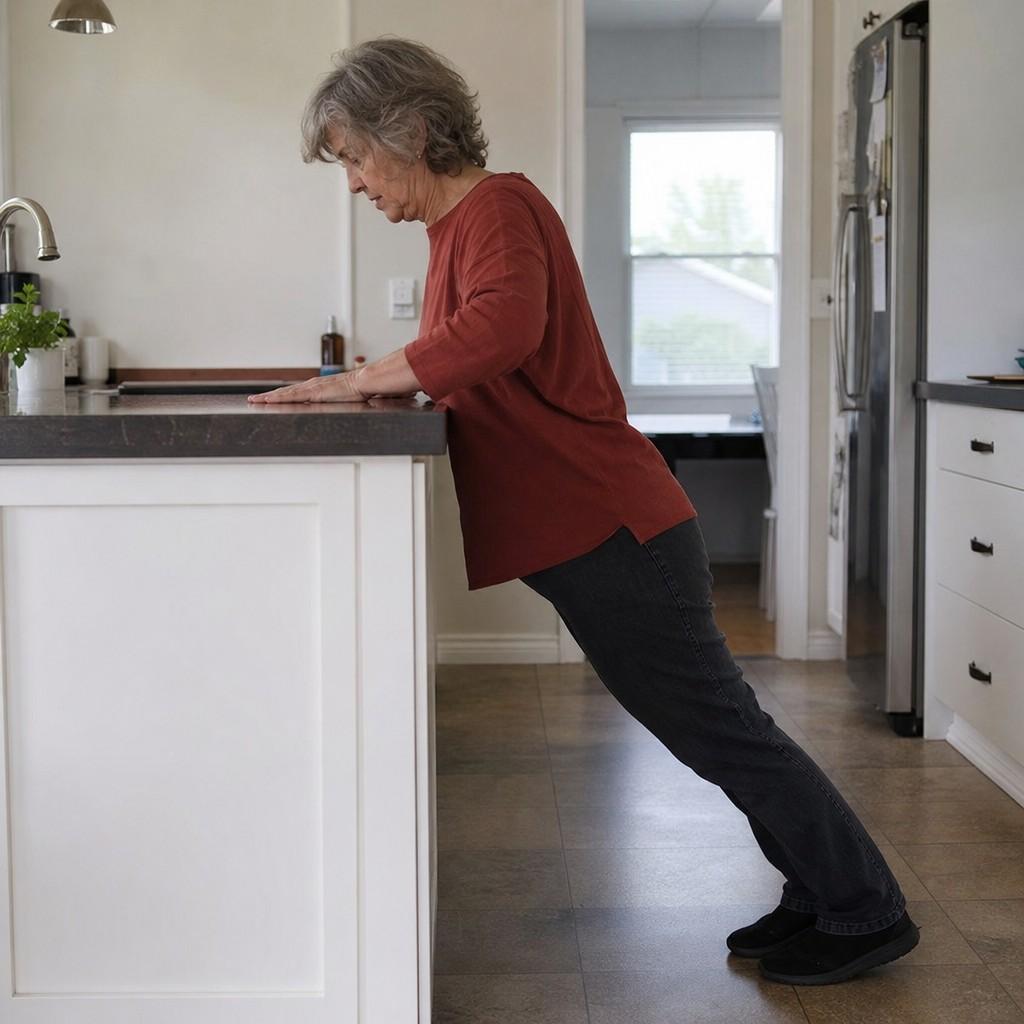
- Wall or counter push-ups. Stand arm’s length from a wall or counter, hands flat, lower your chest toward it, then push back. The higher your hands, the easier it is. Start with 2 sets of 8.
- Step-ups. Step up onto the bottom stair or a low, stable step, then back down. Start with 2 sets of 6 per leg, holding the rail.
- A carry. Pick up a heavy shopping bag, a watering can, or a single dumbbell and walk it across the room and back, twice. This trains grip, core, and posture at once.
That is the whole session. Four moves, about fifteen minutes, twice a week.
Progress by making it slightly harder each week, not by adding days. Add a rep or two, lower your hands on the push-up, stop using your hands on the sit-to-stand, carry something heavier. When 2 sets of 12 feels easy, that movement is ready for more.
Write the sessions on a calendar and tick them off. The first month is about showing up twice a week, nothing fancier than that.
“But I’m worried…”
Most people starting after 50 carry one of three quiet worries. None of them holds up.
The first is that you have left it too late.
It hasn’t.
That 1990 study answered it directly: people in their 90s built strength, so a body in its 50s or 60s has far more room to work with.
The second is bad knees or joints, the fear that lifting will wear them out. This is backwards more often than not. Movement is usually the treatment for stiff joints, not the threat to them. Strong muscles around a joint take load off it. Start gently, keep the range pain-free, and build slowly.
The third is never having lifted anything in your life.
That helps.
Beginners make the fastest progress, because the body has the most room to adapt. You are not behind. You are at the start, which is where everyone starts.
If a movement causes sharp or joint pain, as opposed to honest muscle effort, stop and check it with a professional. Caution is sensible. Fear of starting is not.
Start where you are, not where you were. Train the body you have today, and let it do what bodies still do at every age, adapt.
Making it stick
The hard part of strength training after 50 is not the exercises. It is doing them in week six, when the novelty is gone.
Anchor the sessions to something you already do. Right after your Tuesday and Saturday coffee, before you can talk yourself out of it. A fixed slot beats willpower.
Keep the bar low enough to clear on a bad day. Fifteen minutes twice a week is hard to argue your way out of. On a tired week, do the short version rather than nothing. Something keeps the habit alive; perfect kills it.
Track the boring numbers: reps, the height of the step, the weight of the carry. Watching the sit-to-stand go from a struggle to easy is the feedback that keeps people going when motivation runs thin.
Then come back to the chair test in two months. Stand up without your hands, easier than before, and you will have your answer about whether any of this was worth it.