
You get out of the car after a long drive and the first few steps are stiff. You stand up from the couch and the knees and lower back take a moment to remember what they are for.
That creak after sitting is one of the most common things people notice after 50.
It is also one of the most misread. The instinct is to move the stiff joint less, to protect it. Most of the time that is exactly backwards.
Movement is usually the treatment for stiff joints, not the threat to them.
A stiff joint in the morning is a signal to move more, not a warning to move less. The trick is starting gently and often, not stopping.
Why we stiffen after 50
Two things happen, and neither is cause for alarm.
The first is simply less movement. A joint that sits still for hours gets less of the motion that keeps it loose. Work gets more sedentary, the long days on your feet thin out, and stiffness fills the gap.
The second is normal change in the joints and the tissue around them. Cartilage gets a little thinner, the fluid that lubricates a joint moves a little less freely, and muscles and tendons lose some of their stretch. This is ordinary aging, not damage, and it does not mean the joint is wearing out.
Stiff in the morning is normal; it is not a sign you are breaking down. It is a sign the body wants more movement than it has been getting.
Motion really is lotion
There is an old line in physical therapy that motion is lotion, and the evidence behind it is solid.
Take one of the most common worries people bring past 50: an achy, stiff knee, the kind often labeled osteoarthritis. The natural fear is that using it will grind it down faster, so rest must be safer.
Clinical guidance points the other way. For knee osteoarthritis, gentle exercise and regular movement are recommended as a core part of managing it, not something to avoid. Moving the joint within a comfortable range feeds the cartilage, keeps the surrounding muscles strong, and tends to ease stiffness rather than worsen it.
That reframe is worth sitting with, because the fear is so common.
The joint you are afraid to move is usually the one that most needs gentle motion.
A stiff joint wants movement, not rest. Move it gently and often, and it loosens; protect it from all motion, and it stiffens further.
None of this means pushing into sharp pain. It means the default for everyday stiffness is to move, calmly and within range, rather than to wait it out on the couch.
A simple daily mobility routine
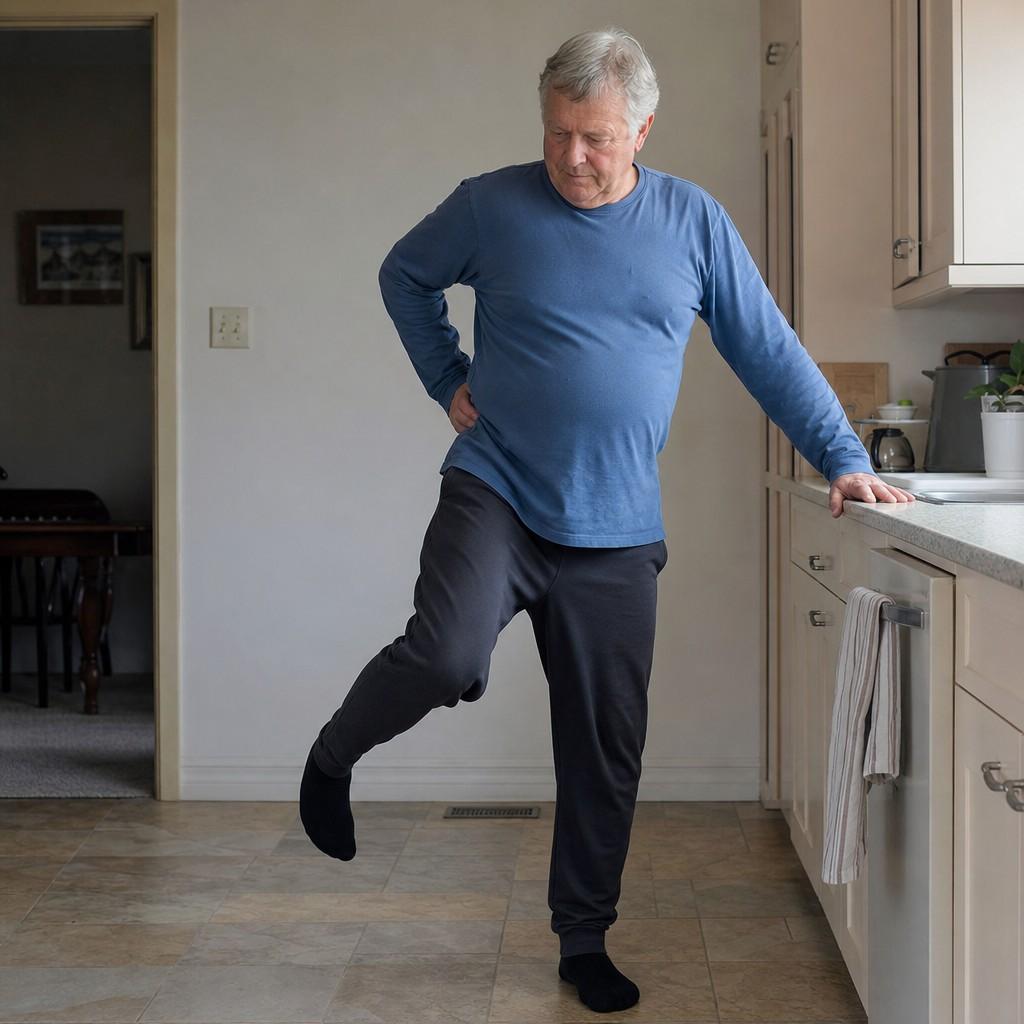
Here is the routine. It takes a few minutes, needs no equipment, and works the body from the top down so nothing gets skipped.
Move slowly through each one. Stay inside a comfortable range, breathe, and never bounce or force it. If a move bites with sharp pain, ease off.
- Neck turns and tilts. Slowly turn your head to look over one shoulder, then the other. Then tilt one ear toward that shoulder, then the other side. A handful each way, smooth and gentle.
- Shoulder rolls and reaches. Roll the shoulders backward several times, then forward. Then reach both arms overhead as far as is comfortable and lower them. This wakes up the shoulders and upper back you hold tight at a desk.
- Standing spine twists. Stand with feet apart, arms loose, and turn your upper body gently left and right, letting the arms swing. Keep the hips facing mostly forward. Five or six each way.
- Hip circles and standing marches. Hands on hips, make slow circles with the hips one way, then the other. Then march in place, lifting each knee to a comfortable height a dozen times. This loosens the hips and lower back, the usual stiffness from sitting.
- Knee bends and ankle circles. Holding a counter for balance, do a few slow, shallow knee bends, only as deep as feels easy. Then lift one foot and draw slow circles with the ankle, each direction, and switch. This keeps the knees and ankles moving for stairs and uneven ground.
That is the whole thing. Top to toe, a few minutes, every day.
Done daily, this is enough to keep the main joints loose. It is not a workout and it does not need to be. It is the gentle, regular motion the joints were missing.
How to do it well
A few small things make this work better.
Little and often beats one long stretch session. A few minutes most days does far more for stiffness than a single long stretch once a week. The joints respond to regular motion, not to the occasional heroic effort.
This is the same rule that governs almost everything after 50.
Consistency beats intensity; small repeatable habits outlast any program.
Warm joints also move more easily than cold ones. Doing the routine after a short walk, or after a warm shower, means the tissues are already loosened and the range comes easier. First thing on a cold morning is fine too, just go a little gentler until things free up.
And the line you never cross is sharp pain. Honest stiffness easing as you move is the goal. A sharp or sudden pain in the joint is a stop sign, not something to push through.
Stay inside the range that feels like easing, not the range that feels like forcing.
When stiffness is worth a doctor’s look
Most everyday stiffness is the ordinary kind that loosens once you move. Some is worth checking.
This is general information, not medical advice; if a joint is suddenly stiff and you do not know why, is hot or swollen or red, hurts on one side only, or simply will not ease with gentle movement, have a doctor take a look before carrying on.
That is not a reason for fear. It is the sensible exception to an otherwise simple rule.
For the ordinary creak after the car or the couch, the answer is rarely rest.
It is to move, gently, a little every day.